Saturday, October 28, 2023

A Snapshot of Cruise Crash Reporting Transparency: July & August 2023

A comparison of California Cruise robotaxi crash reports between the California DMV database and the NHTSA SGO database reveals significant discrepancies in reporting. 31 crashes reported to NHTSA do not appear in the California DMV database. This includes seven unreported injury crashes. Of special note is the Cruise crash with a fire truck that caused serious injury to an occupant of the Cruise robotaxi does not appear as a California DMV crash report. To be sure, Cruise might not be legally required to file these reports, but the situation reveals an apparent lack of transparency.

Comparison Results:

39 crashes were identified across both databases for the date-of-crash months of July 2023 through August 2023. The comparison was performed on October 28, 2023, so there was adequate time for all such crashes to have been reported.

Each database was missing one or more crashes found in the other database:

  • 39 crashes in the NHTSA base, including 8 also found in the CA DMV database.
  • 31 crashes reported to NHTSA were not in the California DMV database
  • The California DMV database was in particular missing SEVEN (7) crash reports which indicated an injury had occurred or might have occurred.
  1. NHTSA 30412-5968: Other car ran a red light striking Cruise; passenger of other vehicle treated on scene for minor injury.
  2. NHTSA 30412-5982: Other car ran into Cruise; passenger of other vehicle transported by EMS for further evaluation. Possible injury ("unknown" injury status).
  3. NHTSA 30412-6144: Cruise crash with fire truck; serious injury reported to passenger
  4. NHTSA 30412-6145: Cruise reversing contacted cyclist; minor injury reported to cyclist
  5. NHTSA 30412-6167: Cruise rear-ended after braking; minor injury reported to other vehicle driver
  6. NHTSA 30412-6175: Cruise hit pedestrian crossing in front of it (said to be crossing against light); moderate injury to pedestrian
  7. NHTSA 30412-6270: Cruise hit from behind after stopping to yield to pedestrian in crosswalk; minor injury to passengers inside AV
Two crashes involved non-motorists:
  • 30412-6145 with a cyclist
  • 30412-6175 with a pedestrian

        Why the Disparity?

        The thing that makes this complicated is that CA DMV does not require reporting crashes for "deployment" operation -- just for "testing" operation. Apparently when the regulations were written they did not anticipate that companies would "deploy" immature technology, but that is exactly what has happened.

        It is difficult from available information to check how Cruise is determining which crashes must be reported to California DMV (testing) and which do not have to be reported (deployment). In practice it might boil down to a management decision which ones they want to report, although there might be some less arbitrary internal decision criterion in use.

        CA DMV should require all companies to provide them with unredacted copies of all NHTSA SGO reports to provide improved transparency. For the foreseeable future, making a distinction between "testing" and "deployment" with no driver in the vehicle serves no useful purpose, and impairs transparency. If there is no driver it is a deployment, and should be held to the standards of a production vehicle, including reporting both crashes and driving behavior that puts other road users at undue risk. This is true for all companies, not just Cruise.

        Other notes:

        • CA DMV reports have the street names, yet Cruise redacts this same information from reports filed with NHTSA claiming it is "confidential business information." It is difficult to understand how information publicly reported by California can be classified as "confidential."
        • The NHTSA database does not have the date of the crash, although the California database has that information.
        • Crashes considered were for reported incident dates of July & August 2023, considering only uncrewed (no safety driver) operation.
        • It is our understanding that Cruise is not required to report all crashes that occur during deployment to California DMV. So it is possible that these reporting inconsistencies are still in accordance with applicable regulations.
        • All crashes on this spreadsheet in the NHTSA database list the "driver/operator type" as "Remote (Commercial / Test)" so it is not possible to distinguish whether the vehicle was considered in commercial service at the time of the crash. 
        • At the time of this posting the tragic Oct. 2nd severe injury crash that involved a Cruise robotaxi dragging a pedestrian who had been trapped under the vehicle has also not been reported, while another crash on Oct 6th has. There is nothing on the Oct 6th CA DMV form to indicate that the reported crash was specific to a testing permit vs. deployment permit.

        Review status: 

        This data has not been peer reviewed. Corrections/additions/clarifications are welcome to improve accuracy. The data analysis results are included below.

        Google Spreadsheet link:  https://docs.google.com/spreadsheets/d/1o9WWzMpiuum-QHZk9goY68gnBZuRC1InxUSMa7-h4DU/edit?usp=sharing

        Data sources: 


        Updated 10/30/2023 to incorporate three more crash reports found in a wider search of the SGO database. All CA DMV crash reports have now been identified in the SGO database.


        Friday, October 27, 2023

        The Cruise Safety Stand-Down -- What Happens Next?

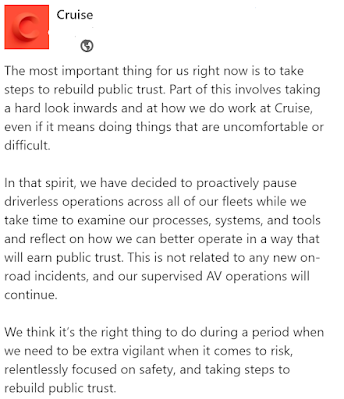
        Cruise has announced a fleet-wide safety stand-down. This involves suspending driverless operations in all cities, reverting to operation only with in-vehicle safety drivers.

        I'm glad to see this step taken. But it is crucial to realize that this is the first step in what it likely to prove a long journey. The question is, what should happen next?


        Loss of public trust is an issue as they say. And perhaps there was an imminent ban in another state forcing their hand to be proactive. But the core issues almost certainly run deeper than mismanaging disclosure of the details of a tragic mishap and doing damage control with regulatory trust. 

        The real issues will be found to have their roots in the culture of the company. Earnest, smart employees with the best of intentions can be ineffective at achieving acceptable safety if the corporate culture undermines their official company slogan of "safety first, always."

        This is the time to ask the hard questions. The answers might be even harder, but they need to be understood for Cruise to survive long term. It is questionable whether they could survive a ban in another state. But escaping that via a stand-down only to implement a quick fix won't be enough. If we see business as usual restored in the next few weeks, that is almost certainly a shallow fix. It will simply be a matter of time before a future adverse situation happens from which there will be no recovery. 

        This is the moment for Cruise to decide to lean into safety.

        The details are too much for a post like this, but the topics alone indicate the scope of what has to be considered:
        • Safety engineering -- Have they effectively identified and mitigated risks?
        • Operational safety -- Safety procedures, inspections, maintenance, management of Operational Design Domain limits responsive to known issues, field data feedback, etc.  This includes ensuring their Safety Management System (SMS) is effective.
        • System engineering -- Do the different pieces work together effectively? This includes all the way from software in 3rd party components to vehicle integration to ability of remote operators to effectively manage gaps in capabilities ... and more
        • Public messaging and regulatory interface -- Building genuine trust, starting with more transparency. Stop the blame game; accept accountability. Own it.
        • Investor expectations -- Determine a scaling plan that is sustainable, and figure out how to fund it in the likely case it is longer than what was previously promised
        • Definition of acceptable safety -- More concrete than seeing how it turns out based on crash data, with continual measurement of predictive metrics
        • Safety culture -- Which underlies all of the above, and needs to start at the top.
        And I'm sure there are more; this is just a start.

        Near-term, the point of a safety stand-down is to stabilize a situation during uncertainty. The even more important part comes next: the plan to move forward. It will take weeks to take stock and create a plan, with the first days simply used to organize how that is going to happen. And months to execute that plan. Fortunately for Cruise there is an existing playbook that can be adapted from Uber ATG's experience with their testing fatality in 2018. Cruise should already have someone digging into that for initial ideas.

        An NTSB-style investigation into this mishap could be productive. I think such an investigation would be likely to bring to light new issues that will be a challenge to the whole industry involving expectations for defensive driving behaviors and post-crash safety. If NTSB is unable to take that on, Cruise should find an independent organization who can do something close. But such an investigation is not the fix, and cultural improvements at Cruise should not wait for one to conclude. However, an independent investigation can be the focal point for deeper understanding of the problems that need to be addressed.

        ------------------------------------------------

        Philip Koopman is a professor at Carnegie Mellon University in Pittsburgh Pennsylvania, USA, who has been working on self-driving car safety for more than 25 years.   https://users.ece.cmu.edu/~koopman/

        Wednesday, October 25, 2023

        My Talk at a SF Transportation Authority Board meeting

        On October 24th I had the privilege of testifying at a San Francisco CTA board meeting regarding autonomous vehicle safety. The session started with SFCTA and SFMTA describing the challenges they have had with robotaxis, my talk, and then a series of Q&As about additional relevant topics. The robotaxi companies were invited to participate but declined. The news of the CA DMV suspension of Cruise permits broke as the hearing was starting, adding some additional context to the hearing.

        We have all heard the hype and marketing from the robotaxi companies. This event gave air time to the challenges faced by cities that must be resolved for this technology to succeed at scale.

        • Information about the event:  (link)
        • Full hearing video:  (link
          • Start at 33:48 (click on item 11 in the index to fast forward to that point) for the full segment including SFCTA and SFDMV.
          • My talk starts at 1:10:25
        • My talk only, live recording:  Youtube | Archive.org
        • Slides for my talk (link to acrobat)
        The robotaxi companies were invited, but declined to participate in this event. You can see what they have to say from the transcript of a CPUC status conference held on August 7, 2023: https://docs.cpuc.ca.gov/PublishedDocs/Efile/G000/M517/K407/517407815.PDF

        Direct link to YouTube talk:


        Saturday, October 21, 2023

        Safety Analysis of Two Cruise Robotaxi Pedestrian Injuries

        Cruise has now had two pedestrian injuries in San Francisco, with the more severe one being complicated because it involved a pedestrian first hit by another vehicle.  NHTSA has launched an investigation based on those injuries and at least two other public video reports of close encounters. This makes available the relevant crash reports, so we have more direct information about what happened. The question asked in this piece is what can be done to avoid similar crashes in the future.


        On a numbers basis, two pedestrian injuries in a span of fewer than six weeks for a fleet of a couple hundred vehicles in San Francisco is a concern, so this is worth some analysis based on available information.

        • First injury: Aug. 26, 2023.  A pedestrian stepped off the curb into a crosswalk right in front of a Cruise vehicle at the change of a traffic light. The Cruise swerved, then braked. Impact at 1.4 mph. Pedestrian transported by EMS.
        • Second injury: Oct 2, 2023. A pedestrian crosses on the opposite side of a cross-street in front of the Cruise vehicle and another vehicle next to it. Both vehicles proceeded through the intersection as a pedestrian was in a crosswalk across their paths. The other vehicle struck the pedestrian at an undisclosed speed, who was then run over by the Cruise vehicle and trapped under it with severe injuries.
        In both cases the injuries were severe enough to require transport. For the second crash the pedestrian was almost completely underneath the rear of the vehicle.  (It is worth noting these descriptions are written 100% by Cruise. The reader should assume the most favorable-to-Cruise possible interpretation of events has been presented. If something obviously relevant is omitted, such as the impact speed for the second injury, one is justified in assuming it would be unfavorable to Cruise if disclosed.)

        Cruise, predictably, blames others for both crashes, although in both cases without review of the video it is difficult to be sure that is really true. However, we set blame aside and instead ask the question: what can be done to avoid the next pedestrian injury in similar circumstances.

        First Pedestrian Crash


        For the first crash, the question is whether a reasonable human driver would have had contextual clues that this pedestrian was about to enter the crosswalk even though the light had changed. For example, were they running to catch a bus pulling up to a stop across the street?  Were they "distracted walking?" Or were they at a complete stop on the curb and literally jumped out into the street? Opportunities for improvement include asking these questions:
        • Were there obvious contextual clues that the pedestrian would attempt a last second crossing? What are common cases, and are they covered by the Cruise AV design?
        • Why did the vehicle swerve before stopping instead of doing both at once?
        • Could/should the Cruise vehicle have followed a less aggressive acceleration profile given the likely risk of a pedestrian entry into the crosswalk in that type of circumstance?

        Second Pedestrian Crash


        For the second crash, things are more complicated. Let's break down the sequence, taking into account the initial setup sketched below (note that both vehicles are in the middle of an intersection, but the sketch tool I used did not make this easy to represent):

        1. There are two vehicles starting through an intersection, side by side, with two lanes in that direction of travel. From a top view the other, human driven, dark-colored vehicle is on the left (faster lane) and the lighter-colored Cruise is on the right (curb lane).
        2. A pedestrian is walking across the far side of the intersection in the crosswalk. At the same time, both vehicles accelerate into the intersection. The most likely situation is the Cruise vehicle was a bit behind the other vehicle (although this is an educated guess based on the description of the events).
        3. Cruise says the pedestrian entered the crosswalk after the light changed, crossed in front of the Cruise vehicle, then stopped in the other vehicle's lane. The other driver presumably thought the pedestrian would clear the travel lane in time, and did not slow down.
        4. The other vehicle hit the pedestrian. Cruise says the pedestrian was deflected back into the Cruise vehicle's lane.
        5. The Cruise vehicle "braked aggressively" in response to a surprise pedestrian appearing in its lane, but hit the pedestrian shortly after.
        6. The Cruise vehicle had sufficient forward speed that it ran over the pedestrian and came to a stop with the pedestrian trapped under the rear axle. Both of the pedestrian's feet protruded from under the vehicle by the left rear tire, with that tire on top of one leg. (Photo link below.)
        7. The pedestrian was severely injured by a combination of the two vehicle strikes. Information about the ultimate outcome for that pedestrian is not currently available, although we hope that a recover is quick and as complete as possible.

        California Rules of the Road have an interesting requirement for crosswalks:

        "(c) The driver of a vehicle approaching a pedestrian within any marked or unmarked crosswalk shall exercise all due care and shall reduce the speed of the vehicle or take any other action relating to the operation of the vehicle as necessary to safeguard the safety of the pedestrian."  (emphasis added)

        It is interesting to ask if the Cruise vehicle actually exhibited "all due care."  It likely did not reduce speed from its normal green light acceleration, or Cruise would have taken credit for having done so.  (If they want to provide more details I will gladly update this statement.)

        Of note is the Cruise position that their vehicle stopped as quickly as possible once the pedestrian was in their lane, in effect claiming the collision was unavoidable. But that position is not necessarily true in the larger context, especially if one learns from this crash for the next potential pedestrian crosswalk collision. The question is when the Cruise AV could have stopped. There are at least three possible decision points for stopping to avoid this collision with the pedestrian, and the Cruise vehicle appears not to have exercised the first two:

        • The light changes green, but there is a pedestrian still in the crosswalk in the Cruise vehicle's direction of travel in front of the Cruise vehicle. Did it slow down?  Or execute a normal acceleration because it predicted the pedestrian would be clear by the time it got there?   A prudent human driver would have waited, or more likely crept forward while waiting to signal cars behind it not to honk for failing to recognize a green light.
        • The pedestrian clears the Cruise lane, but the Cruise vehicle clearly sees the pedestrian about to be hit by the adjacent vehicle. The Cruise vehicle could have (I would argue should have) stopped to avoid being close to an injury event. Expecting it to predict a pedestrian collision trajectory is asking a lot -- but it should have stopped precisely because it cannot predict what will happen after such a collision. Safety demands not going fast past a pedestrian who is about to be hit by another vehicle in an adjacent lane. But this is precisely what the Cruise vehicle did.
        • The pedestrian lands in the Cruise lane and the Cruise vehicle has not slowed down yet. By then it is too late, and it runs over the pedestrian.  This could likely have been avoided by a prudent driving strategy that addresses the previous two decision points.

        The Redacted Confidential Business Information

        (This section added October 25, 2023 based on new information.)

        California DMV issued an order suspending the driverless operating permits for Cruise robotaxis on October 24, 2023 as a response to the circumstances of this second crash.  Link to order here.

        This order brought to light that after the vehicle had stopped post-crash, it started movement again with the pedestrian still under the vehicle, dragging that victim about 20 feet at a speed up to 7 mph, which was said to contribute to severe injuries. This strongly suggests the vehicle did not account for a pedestrian being trapped underneath it when deciding to move. (It is possible a remote operator was unaware of the trapped pedestrian and remotely commanded a pull-to-side maneuver. We'll have to see what is revealed during any investigation.)

        Cruise also published a blog post with additional information that day. A straightforward update to the crash report is to add at the end as at least part of the "redacted confidential business information" the following (quoted from the Cruise blog post): 
        "The AV detected a collision, bringing the vehicle to a stop; then attempted to pull over to avoid causing further road safety issues, pulling the individual forward approximately 20 feet."

        This certainly makes Cruise look bad, but that is not an acceptable reason for a redcation. It is difficult to understand how this can reasonably be characterized as "confidential business information" in a mandatory crash report.

        Calling Emergency Services

        Also crucial for practical safety, but barely talked about, is notification of emergency services ("call 911"). News reports indicate that a passer-by called 911, not Cruise. In fact, in neither collision report do they take credit for notifying emergency services. This is a glaring omission that needs to be addressed.

        Consider: they had a vehicle tire on top of a pedestrian's leg and did not call 911. (Again, if this is incorrect I will update this statement when I get that information.) That's a HUGE problem nobody is talking about. A human driver would have realized they just ran someone over and either called 911 or asked someone to do so. If there had been no passer-by, how many minutes would that pedestrian have been trapped under the car before help was summoned?

        The Cruise AV and its support team need to realize an injury has happened and take immediate action. It would be no surprise if the remote operators had no idea what the vehicle had run over. By the time they download and review video logs (or whatever) that pedestrian has been trapped under the vehicle for a while. That's not acceptable. They need to be able to do better.

        Cruise Safety Record

        The first pedestrian injury happened just over two weeks after the August 10th California PUC meeting that granted operating permits to Cruise. That report was overshadowed by the crash apparently due to failure to yield to a fire truck on August 17th. That night also saw another injury involving a collision to a different vehicle driver.  So we are seeing a steady stream of injuries.

        Cruise blames crashes on other parties to the maximum degree possible, and ignores injuries where it is less than 50% at fault (there have been others; notably a very ill-advised left turn maneuver by a Cruise robotaxi that resulted in multiple injuries).  Safety is not achieved by blaming others. If Cruise vehicles are crashing and injuring people more often than other vehicles, then that is an increased rate of injury regardless of blame.

        A company with a responsible safety culture would be asking what they can do to reduce the risk of future injuries -- regardless of blame. We will have to wait to see the outcome of this NHTSA investigation, and whether Cruise proactively improves safety or waits for NHTSA to force the issue.

        As a note to likely responses to this analysis: comparisons to human driver errors are not productive. Indeed, another driver hit the pedestrian first in the second crash. But another driver being negligent does not forgive imprudent driving behavior from a robotaxi that is being relentlessly touted as safer than human drivers. They should be continuously improving, and our hope is that this analysis highlights areas that they and other robotaxi companies need to improve.

        Supporting Information


        Thursday, October 5, 2023

        Defining a Computer Driver for Automated Vehicle Accountability

        This 25-minute video talks about the concept of a Computer Driver to resolve the ambiguity and industry tapdancing we're seeing about who might be negligent for a crash when automation is driving the car. This creates a framework for both SAE Level 2 and Level 3 features that makes it explicit which of the computer driver or the human driver has the duty of care for safety at any given time.

        Topics:

        • Why product liability is not enough to get the job done
        • Tort law for engineers
        • Assigning a duty of care to promote accountability
        • Implications of defining a computer driver
        • Duty of care for conventional, fully autonomous, and testing features
        • The awkward middle: transferring the duty of care for supervisory mode
        • The urgency of defining a computer driver while we wait for longer-term regulations
        Materials:

        YouTube Video


        Saturday, September 30, 2023

        Cruise publishes a baseline for their safety analysis

        Summary: a Cruise study suggests they are better than a young male ride hail driver in a leased vehicle. However, this result is an estimate, because there is not yet enough data to have a firm conclusion.


        I am glad to see Cruise release a paper describing the methodology for computing the human driver  baseline, which they had not previously done. Same too for their "meaningful risk of injury" estimation method. And it is good to see a benchmark that is specific to a deployment rather than a US average.

        Cruise has published a baseline study for their safety analysis here:
         blog post:  https://getcruise.com/news/blog/2023/human-ridehail-crash-rate-benchmark/
         baseline study: https://deepblue.lib.umich.edu/handle/2027.42/178179
        (note that the baseline study is a white paper and not a peer reviewed publication)

        The important take-aways from this in terms of their robotaxi safety analysis are:
        • The baseline is leased ride hail vehicles, not ordinary privately owned vehicles
        • The drivers of the baseline are young males (almost a third are below 30 years old)
        • A "meaningful risk of injury" threshold is defined, but somewhat arbitrary. They apparently do not have enough data to measure actual injury rates with statistical confidence. Given that we have seen two injuries to Cruise passengers so far (and at least one other injury crash), this is not a hypothetical concern.
        It should be no surprise if young males driving leased vehicles as Uber/Lyft drivers have a higher crash rate than other vehicles. That is their baseline comparison. In fairness, if their business model is to put all the Uber and Lyft drivers out of work, perhaps that is a useful baseline. But it does not scale to the general driving population.

        A conclusion that a Cruise robotaxi is safer (fewer injuries/fatalities) than an ordinary human driver is not quite supported by this study.
        • It is not an "average" human driver unless you only care about Uber/Lyft. If that is the concern, then OK, yes, that is a reasonable comparison baseline.
        • I did not see control for weather, time of day, congestion, and other conditions in the baseline. Road type and geo-fence were the aspects of ODD being used.
        • There is insufficient data to have a conclusion about injury rates, although that will come somewhat soon
        • We are a long way away from insight into how fatality rates will turn out, since the study and Cruise have about 5 million miles and San Francisco fatality rate is more like one per 100 million miles
        • The Cruise emphasis on "at fault" crashes is a distraction from crash outcomes that must necessarily include the contribution of defensive driving behavior (avoiding not-at-fault crashes)
        This study could support a Cruise statement that they are on track to being safe according to their selected criteria. But we still don't know how that will turn out. This is not the same as a claim of proven safety in terms of harm reduction.

        A different report does not build a model and estimate, but rather compares actual crash reports for robotaxis with crash reports for ride hail cars and comes to the conclusion that Cruise and Waymo operated at 4 to 8 times as many crashes as average US drivers, but that their crash rate is comparable to ride hail vehicles in California.

        https://www.researchgate.net/publication/373698259_Assessing_Readiness_of_Self-Driving_Vehicles

        Thursday, September 28, 2023

        No, Mercedes-Benz will NOT take the blame for a Drive Pilot crash

        Summary: Anyone turning on Mercedes-Benz Level 3 Drive Pilot should presume they will be blamed for any crash, even though journalists are saying Mercedes-Benz will take responsibility.

        Driver playing Tetris while using Drive Pilot

        Drive Pilot usage while playing Tetris. (Source)

        There seems to be widespread confusion about who will take the blame if the shiny new Mercedes-Benz Drive Pilot feature is involved in a crash in the US. The media is awash with non-specific claims that amount to "probably Mercedes-Benz will take responsibility."  (See here, herehere, and here)

        But the short answer is: it will almost certainly be the human driver taking the initial blame, and they might well be stuck with it -- unless they can pony up serious resources to succeed at a multi-year engineering analysis effort to prove a design defect.

        This one gets complicated. So it is understandable that journalists on deadline simply repeat misleading Mercedes-Benz (MB) marketing claims without necessarily understanding the nuances. This is a classic case of "the large print giveth, and the small print taketh away" lawyer phrasing.  The large print in this case is "MERCEDES-BENZ TAKES RESPONSIBILITY" and the small print is "but we're not talking about negligent driving behavior that causes a crash." 

        The crux of the matter is that MB takes responsibility for product defect liability (which they have to any way -- they have no choice in the matter). But they are clearly not taking responsibility for tort liability related to a crash (i.e., "blame" and related concepts), which is the question everyone is trying to ask them.

        Like I said, it is complicated.

        The Crash

        Here is a hypothetical scenario to set the stage. Our hero is the proud owner of a Drive Pilot equipped vehicle, and has activated the feature in a responsible way. Now they are merrily playing Tetris on the dashboard, reading e-mail, watching a movie, or otherwise using the MB-installed software according to the driver manual. The car is driving itself, and will notify our hero if it needs help, as befits an SAE Level 3 "self-driving" car feature.

        A crash to another vehicle happens ahead in the road, but that other, crashed vehicle is out of the flow of traffic. So our hero's car sees a clear road ahead and does not issue a takeover request to the driver. Our hero is currently engrossed in watching a Netflix movie on the dashboard (using the relevant MB-approved app) full of explosions in an action scene, and does not notice.

        Meanwhile, in the real world, a dazed crash victim child wanders out of their wrecked vehicle onto the roadway. But our hero's MB vehicle has a hypothetical design defect in that it can't detect children reliably. 

        Our hero's vehicle hits and kills that child. (I emphasize this is a hypothetical, but plausible, defect. The point is that we, and the owner, have no way of knowing if such a defect is present right now. Other crash scenarios will play out in a similar way.)

        Our hero then is charged by the police with negligent homicide (or the equivalent charge depending on the jurisdiction) for watching a movie while driving. Additionally a lawsuit for $100M is filed both against the driver and Mercedes-Benz for negligent driving under tort law. The judge determines that Mercedes-Benz did not have a duty of care to other road users under the relevant state law, so the tort lawsuit is changed to be just against the driver.

        What happens to our hero next? 

        Will MB will step up and pay to settle the $100M lawsuit? Will they also volunteer to go to jail instead of our hero? They have not actually said they will do either of these things, because their idea of "responsibility" is talking about something entirely different.

        Tort Law

        I will say right here I am not a lawyer. So this is an engineer's understanding of how the law works. But we are doing pretty basic legal stuff here, so probably this is about right. (If you are a journalist, contact law professor William Widen for his take.)

        Tort law deals with compensation for a "harm" done to others. Put very simply, every driver has a so-called "duty of care" to other road users to avoid harming them. Failing to exercise reasonable care in a way that proximately causes harm can lead to a driver owing compensation under tort law. Unless there is a clear and unambiguous transfer of duty of care from our hero to the MB Drive Pilot feature, our hero remains on the hook under tort law.

        The problem is that the duty of care remains with our hero even after activating Drive Pilot. Pressing a button does not magically make a human driver (who is still required to remain somewhat attentive in the driver seat) somehow not an actual driver under current law.

        But, wait, you say. Mercedes says They Take Responsibility!  (This message is currently being splashed across the Internet in breathless reviews of how amazing this technology is. And the technology is truly amazing.)

        Well no, not according to tort law they don't take responsibility. Instead, the MB position is that the human driver retains the duty of care for potential harm to other road users when using their Level 3 Drive Pilot system -- even while playing Tetris. Their representative admitted this on stage a couple weeks ago in Vienna Austria. I was in the crowd to hear it. Quoting from Junko Yoshida in that article:  "Yes, you heard it right. Despite its own hype, Mercedes-Benz is saying that the driving responsibility still rests on the human driver in today’s L3 system."

        So what does MB mean when they "accept responsibility?"   The answer is -- they are not accepting the responsibility you think they are. In particular, they are not accepting liability that stems from negligent driving behavior.

        Product Defect/Liability

        A statement from Mercedes-Benz issued to the press makes it clear that MB accepts responsibility for product defects, but not tort law liability.  A key phrase is:  "In the context of Drive Pilot, this means that if a customer uses the system as intended and instructed and the system fails to perform as designed, we stand behind our product."  (Source here.)

        This means that in our hypothetical scenario, our hero can hire a lawyer, who then hires a team of engineers to look at the engineering of Drive Pilot to see if it "performs as designed." Expect someone to pay $1M+ for this effort, because this is a full-on, multi-year product defect investigation. Maybe they find a defect. Maybe they don't, even if a defect is really there. Or maybe they find a reproducible defect, and it is so complex the jury doesn't buy the story. And maybe the performance as designed is that sensors will only detect 98% of pedestrians, and the victim in this tragic scenario is just one of that unlucky 2%. 

        Perhaps the owner manual says our hero should have been alert to dazed crash victims wandering in the travel lane. Even while playing Tetris.  (That owner manual is not released yet, so we'll just have to wait and see what it says.) In which case MB will blame our hero for being negligent -- as if one is likely to notice a crash while watching the latest war movie with a high end sound system. And what if the owner didn't bother to read the manual and instead just took the dealer and dozens of car journalists saying "MB accepts responsibility" at face value. (OK, well maybe that's a different lawsuit. But we're talking a legal mess here, not a clear acceptance of the duty of care for driving by MB.)

        Who is holding the bag here?

        It's probably our hero, and not Mercedes-Benz holding the bag. Even though our hero believed the MB marketing that said it was OK to play video games instead of looking out the front window, and believed their claims of superior engineering quality, and so on.

        Maybe a product defect can be found. Finding one might influence a jury in a tort law case to blame MB instead of our hero. (But that's not guaranteed. And what if the jury finds a reason to blame both?) Perhaps our hero has a robust umbrella insurance coverage instead of the state minimum that covers such a loss. Perhaps our hero is so broke they are "judgement proof" (no assets to collect -- but owning a Mercedes-Benz makes that less likely I'd think).

        In effect, what we'll see is that the human driver will almost certainly be presumed guilty of negligence in a crash if watching the dashboard instead of the road, even if the vehicle operational mode is telling them it is OK to do exactly that. The onus will be upon the driver to prove a design defect as a defense. This is difficult, expensive, time consuming, and overall not an experience I would wish on anyone.

        And there is the specter of criminal liability for negligent homicide (or the equivalent). Depending on the state, our hero might be charged criminally based on being the operator or even just the vehicle owner (even if someone else is driving!). It depends. Nobody really knows what will happen until we see a case go through the system. But outcomes so far in Level 2 vehicle automation cases are not encouraging for our hero's prospects.

        Driving a Level 3 vehicle is only for the adventurous

        Perhaps you believe any claim by MB that their feature will never cause a crash while engaged. Ever. Pinkie swear. But they have had recalls for software defects before, and there is no reason to believe this new, complex software is exempt from defects or malfunctions.

        We don't know how this will turn out until a few such crashes make their way through the court system. But there is little doubt that it will be a rough ride for both the drivers and the crash victims after a crash while we see how this sorts out.

        Anyone turning on Drive Pilot should presume they will be blamed for any crash, no matter what Mercedes-Benz says. As even MB admits, the human driver retains the duty of care for safety to other road users at all times, just as in a Level 2 "autopilot"-style system. Marketing statements made by MB about giving time back to the driver don't change that.

        Who knows, maybe MB will decide to stand behind their product and pay out on the behalf of customers who find themselves embroiled in tort law cases. But they have not said they will do so. And maybe you believe that MB engineers are so good, that this particular software will have no defects AND will never mistakenly cause a crash.  But that's not a set of dice I'm not eager to roll.

        This legal ambiguity is completely avoidable by establishing a statutory duty of care for computer drivers that assigns the manufacturer as the responsible party under tort and criminal law. But until that happens, our hero is going to be left holding the bag.

        (Things get even worse if you want to dig into the complexities of the handoff process... but that is a story for another post.)


        Update --  The MB Drive Pilot US manual is out, and it doubles down on these issues.  Drivers are apparently required to notice "irregularities .. in the traffic situation" -- which means paying attention to the road.  And for "obvious circumstances"

        Wednesday, September 27, 2023

        Five questions cities should ask when robotaxis come to town

        If your city is getting robotaxis, here are five questions you should be asking yourself if you are in local government or an advocate for local stakeholders. Some of the answers to these questions might not be easy if you are operating under a state-imposed municipal preemption clause, which is quite common. But you should at least think through the situations up front instead of having to react later in crisis mode.

        (There might well be benefits to your city. But the robotaxi companies will be plastering them over as much media as they can, so there is no real need to repeat them here. Instead, we're going to consider things that will matter if the rollout does not go ideally, informed by lessons San Francisco has learned the hard way.)

        Local citizens have questions for the robotaxi / Dall-E 2

        (1) How will you know that robotaxis are causing a disruption?

        In San Francisco there has been a lot of concern about disruption of fire trucks, emergency response scenes, blocked traffic, and so on. The traffic blockages show up pretty quickly in other cities as well. While companies say "stopping the robotaxi is for safety" that is only half the story. A robotaxi that stays stopped for tens of minutes causes other safety issues, such as blocking emergency responders, as well as disrupts traffic flow.

        How will you know this is happening? Do you plan to proactively collect data from emergency responders and traffic monitoring? Or wait for twitter blow-ups and irate citizens to start coning cars? What is your plan if companies cause excessive disruption?

        (2) How will you share data with companies that they should be using to limit testing?

        For example, you might wish to ask companies not to test near parades, first amendment events, active school zones, or construction areas. Is it easy for companies to access this information, preferably electronically? Are they interested in doing that? Will they follow your requested testing/operational exclusion areas? What do you plan to do if they ignore your requests to restrict testing in sensitive areas?

        (3) How will you ensure testing and operational equity?

        What if disruption, testing incidents, and other issues are concentrated in historically disadvantaged areas? (This might happen due to company policy, but might instead be an unintended emergent result due to higher-than-average population density and emergency response activity in such areas.)

        How will you know whether exposure to testing risk is being imposed in an equitable manner, especially if robotaxi companies claim that where they test is a trade secret?

        If robotaxis are being sold based on service to the disabled and for other social goods, how will you be able to measure whether companies are living up to their promises?

        (4) How will you issue traffic tickets to a robotaxi?

        Some states require a moving violation citation to be issued to a natural person, but robotaxis don't have a driver. Consider proactively moving to get state-level regulations fixed sooner rather than later to correct this. Without the ability to ticket robotaxis you might find yourself without viable enforcement tools for the worst robotaxi behaviors that might occur.

        (5) How can you productively engage with companies despite municipal preemption laws?

        Apparently in some cities there is a good working relationship with between city government and robotaxi operators. In San Francisco the city and the companies are practically at war. There are no magic solutions, but trying hard up front to build bridges before things get tense is better than reacting to bad news.

        -----------------------------

        Saturday, August 26, 2023

        Autonomous Vehicle State Policy Issues (Talk Video)

        The commercial deployment of robotaxis in San Francisco has made it apparent many issues remain to be resolved regarding the regulation and governance of autonomous vehicle technology at the state and local levels. This talk is directed at state and local stakeholders who are considering how to set policies and regulations governing this technology.

        Topics:

        • Getting past Automated Vehicle (AV) safety rhetoric
        • AV safety in a nutshell
          • Safe as a human driver on average
          • Avoiding risk transfer to vulnerable populations
          • Avoiding negligent computer driving
          • Conforming to industry consensus safety standards
          • Addressing other ethical & equity concerns
        • Policy points:
          • Societal benefits
          • Public road testing
          • Municipal preemption
          • SAE Level 2/2+/3 issues
          • Federal vs. state regulation
          • Other policy issues
        • Revisiting common myths


        Washington State policy meeting in which I give this talk and answer questions: https://avworkgroupwa.org/committee-meeting/executive-committee-meeting-15


        Thursday, July 27, 2023

        AV Safety Claims and More on My Congressional Testimony

        I recently had the privilege of testifying before the US House E&C committee on self-driving car safety. You can see the materials here:

        A venue like this does not offer the best forum for nuance. In particular, one can make a precise statement for a reason and have that statement misunderstood (because there is limited time to explain), or misconstrued. The result can be talking past each other for reasons ranging from simple misunderstanding, to ideological differences, to the other side needing to show they are right regardless of the counter-arguments. I do not attempt to cover all topics here; just ones that feel like they could use some more discussion. (See my written testimony for the full list of topics.)

        The venue also requires expressing opinions about the best path forward, which can legitimately have different views. I happen to believe that setting up a requirement to follow safety standards is our best bet to be competitive long term with international competitors (who end up having that same requirement). Others disagree.

        In this blog I have the luxury of spending some time on some areas that could not be covered with as much nuance/detail in the official proceedings.

        US House E&C Hearing on July 26, 2023


        Claims that AVs are already safe are premature

        Ultimately AVs will win or lose based on public trust. I believe that making overly aggressive claims about safety degrade that trust.

        The AV companies are busy messaging that they have already proven are they are better than human drivers, and framing it as a discussion of fatality rates. In other words, they are declaring victory on public road safety in terms of reducing road fatalities. But the data analysis does not support that they are reducing fatalities, and it is still not really clear what the crash/injury rate outcomes are.

        Their messaging amounts to 40,000 Americans die on roads every year. We have proven we are safer. Delaying us will kill people.   (Where "us" is the AV industry.)  (Cruise: "Humans are terrible drivers" and computers "never drive distracted, drowsy, or drunk"Cruise has also published some bar graphs of unclear meaning, because the baseline data and details are not public, and the bars selected tell only part of the story (e.g., "collision with meaningful risk of injury" instead of injuries when we know they have already had a multi-injury crash, which therefore undercounts injuries; and only collisions with "primary contribution" when we know they were partially at fault for that multi-injury crash, even if not at "primary" fault.) I have not seen Cruise explicitly say they have reduced fatalities (they say they "are on track to far exceed this projected safety benefit"), but the implied message of declaring victory on safety is quite clear from them ("our driverless AVs have outperformed the average human drier in San Francisco by a large margin.")

        Other messaging might be based on reasonable data analysis that is extended to conclusions that go beyond the available data. Waymo: "the Waymo Driver is already reducing traffic injuries and fatalities" -- where the fatality rate is an early estimate, and the serious injury rate numbers are small enough to still be in the data collection phase.  Did I say their report is wrong? I did not. I said that the marketing claims being made are unsupported. If they claimed "our modeling projects we are reducing traffic injuries and shows us on track for reducing fatalities" then that might well be a reasonable claim. But it is not the claim they are making. I note their academic-style papers do a much more rigorous job of stating claims than their marketing material. So this is a matter of overly-aggressive marketing.

        It is premature to declare victory. (Did I say the claim of reduced fatalities is definitely false? No. I said it is premature to make that claim. In other words, nobody knows how this will turn out.)

        Waymo and Cruise have 1 to 3 million miles each without a driver. Mean time between human driver fatal crashes is ballpark 100 Million miles (details and nuances, but we know human drivers -- including the drunks -- can do this on US public roads in a good year). So at a few million miles there is insufficient experience to know how fatalities will actually turn out.

        We are much further away from the data it will take to understand fatalities, which ranges from 300 million to 1 billion miles for a high statistical confidence. A single fatality by any AV company in the next year or so would likely prove that AVs are not safe enough, but we don't know if that will happen.

        Missy Cummings has recent results that shows that Waymo has about 4x more non-fatal crashes on non-interstate roads than average human drivers (also on non-interstate roads) -- and Cruise has about 8x more. However, these crash rates are similar to Lyft and Uber in California.  (There is actual research backing up that statement that will be published in due course.)

        Also, even if one company shows it is safe enough, that does not automatically make other companies safe. We've already seen differences between Waymo (no injury crashes) and Cruise (a multi-injury crash). Whether that is just bad luck or representative still takes more data. Industry messaging that amounts to "Waymo is safe therefore all AVs are safe" is also problematic, especially if it claims victory on fatality rates.

        The reality is that both Waymo and Cruise are using statistical models of varying degrees of sophistication to predict their safety outcomes. Predictions can be wrong. In safety predictions often are wrong for companies with poor safety cultures or who decide not to follow industry safety standards -- but we don't find out until the catastrophic failure makes the news. We can hope that won't happen here, but it is hope, not time for a victory dance.

        Summary: Companies are predicting they will reduce fatalities. That is not the same as actually proving it. There is a long way to run here, and the only thing I am sure is there will be surprises. Perhaps in a year we'll have enough data to get some more clarity about property damage and injury crashes, but only for companies that want to be transparent about their data.  It will be even longer to show that the fatality rate is on a par with human drivers. If bad news arrives, it will come sooner. We should not make policy assuming they are safer.

        Blame and AV safety

        Blaming someone does not improve safety if it deflects the need to make a safety improvement. In particular, saying that a crash was not the fault of an AV company is irrelevant to measuring and improving safety. Much of road safety comes not from being blameless, but rather for compensating for mistakes, infrastructure faults, and other hazards not one's own fault. 

        Any emphasis on metrics that emphasizes "but it was not mostly our fault" is about public relations, not about safety.  I guess PR is fine for investors, but baking that into a safety management system means lost opportunities to improve safety. That is not the behavior appropriate for any company who claims safety is their most important priority.  If a company wants to publish both "crashes" and "at fault crashes" then I guess OK (although "at fault" should include partially at fault, not 49% at fault rounds down to 0% at fault). But publishing only "at fault" crashes is about publicity, not about safety transparency. (Even worse is lobbying that only "at fault" crashes should be reported in data collection.)

        On the other hand, it is important to hold AV companies accountable for safety, just as we hold human drivers accountable. A computer driver should have the same duty of care as a human driver on public roads. This is not formally the situation now, and this part of tort law will take a lot of cases to resolve, wasting a lot of time and resources. The manufacturer should be the responsible party for any negligent driving (i.e., driving behavior that would be negligent if a human driver were to do it) by their computer driver. Not the owner, and not the operator, because neither has the ability to design and validate the computer driver's behavior. This aspect of blame will use tort law in its primary role: to put pressure on the responsible party to avoid negligent driving behavior. The same rules should apply to human and computer drivers.

        There is a nuanced issue regarding liability here. Companies seem to want to restrict their exposure to being only product liability, and evade tort law. However, if a computer driver runs a red light, that should be treated exactly as a human driver negligence situation. There should be no need to reverse engineer a huge neural network to prove a specific design defect (product liability) -- the fact of running a red light should be the basis for making a claim based on negligent behavior alone (tort law) without having the burden to prove a product defect. Product liability is more expensive and more difficult to pursue. The emphasis should be on using tort law when possible, and product liability only as a secondary path. That will keep costs down and make deserved compensation more accessible on the same basis it is for human driver negligence.

        Also, aggressively blaming others rather than saying at the very least "we could have helped avoid this crash even if other driver is assigned blame" degrades trust.

        Summary: Statistics that incorporate blame impair transparency. However, it is helpful for tort law to hold the manufacturers accountable for negligent behavior by computer drivers. And you would think computer drivers should have near-zero negligent driving rates? Insisting on product liability rather than tort law is a way for manufacturers to decrease their accountability for computer driver problems, harming the ability other road users to seek justified compensation if harmed.

        Level 2/2+:

        All this attention to AVs is distracting the discussion from a much bigger and more pressing economic and safety issue: auto-pilot systems and the like. The need to regulate those systems is much more urgent from a societal point of view. But it's not the discussion because the auto industry has already gotten itself a situation with no regulation other than a data reporting requirement and the occasional (perhaps after many years) recall.

        Driver monitoring effectiveness and designing a human/computer interaction approach that does not turn human drivers into moral crumple zones needs a lot more attention. It will take a long time for NHTSA to address this beyond doing recalls for the more egregious issues. Tort law (holding the computer driver accountable when it is steering) seems the only viable way to put some guard rails in place in the near- to mid-term.

        Opinion: Level 2/2+ is what matters for the car industry now for both safety and economic benefits. AVs are still a longer term bet. 

        Don't sell on safety:

        Companies should not sell solving the 40K/year fatality problem. There are many other technologies that can make a much quicker difference in that area. And social change for that matter. If what we want is better road safety, investing tens of billions of dollars in robotaxi technology is one of the least economically efficient ways to do this. Instead we could improve active safety systems, encourage a switch to safer mass transit, press harder for social change on impaired/distracted driving, and so on. While one hopes this will long term help with fatalities, this is simply the wrong battle for the industry to try to fight with this technology for at least a decade. (Even if the perfect robotaxi were invented today -- which we are a long way from -- it would take many years to see a big drop in fatalities due to the time to turn over the automotive fleet that has an average age of about 12 years.)

        Companies should sell on economic benefit, being better for cities, being better for consumers, transportation equity, and so on -- while not creating safety issues. Safety promises should simply indicate they are doing no harm. This is much easier to show, assuming it is true. And it does not set the industry up for collapse when the next (remember Uber ATG?) fatality eventually arrives.

        The issue is that any statement about reducing fatalities is a prediction, not a conclusion. I would hope  that car companies would not release a driverless car onto public roads unless they can predict it is safer than a human driver. They should disclose that argument in a transparent way. But it is a prediction, not a certainty. It will take years to prove. Why pick a fight that is so difficult when there is really no need to do so? 

        A smarter way to explain to the public how they are ensuring a safe and responsible release is to use an approach such as:
        1. Follow industry safety standards to set a reasonable expectation of safe deployment and publicly disclose independent conformance checks.
        2. Establish metrics that will be used to prove safety in advance (not cherry-picked after the fact).
        3. Transparent monthly reports of those metric outcome vs. goals
        4. Show that issues identified are resolved vs. continuing to scale up despite problems. Problems includes not only crashes, but also negative externalities on other road users
        5. Publish lessons learned in a generic way
        6. Show public benefit is being delivered beyond safety, again with periodic metric publications.
        Three principles for safety, all of which are a problem with the industry's current adversarial approach to regulatory oversight, are:
        1. Transparency
        2. Accountability
        3. Independent oversight
        It is not only that you need to do those things to actually get safety. It is also that these things build trust.

        Other key points:

        • Any person or organization who promotes the "human drivers are bad, so computers will be safe " and/or the "94% of crashes are caused by human error" talking points should be presumptively considered an unreliable source of information. At this point I feel those are propaganda points. Any organization saying that Safety is their #1 priority should know better.
        • The main challenge to the industry is not regulations -- it is the ability to build reliable, safe vehicles that scale up in the face of the complexity of the real world. Expectations of exponential numbers of cars deploying any time soon seem unrealistic. The current industry city-by-city approach is likely to continue to grind away for years to come. Being realistic about this will avoid pressure to make overly aggressive deployments that compromise safety.
        • In other industries (e.g., aviation, rail) following their own industry standards is an essential part of assuring safety. The car companies should be required to follow their standards too (e.g., ISO 26262, ISO 21448, UL 4600, ISO/SAE 21434, perhaps ISO TS 5083 when we find out what is in it). This varies across companies, with some companies being very clearly against following those standards.
        • There is already a regulatory framework, written by the previous administration. This gives us an existing process with an existing potential bipartisan starting point to move the discussion forward instead of starting from scratch with rule making. That framework includes a significant shift in government policy to require the industry to follow its own consensus safety standards. My understanding is that US Government policy is to use such standards whenever feasible. It is time for US DOT to get with the program here (as they proposed to do several years ago -- but stalled ever since).
        • Absolute municipal and state preemption are a problem, especially for "performance" aspects of a computer driver:
          • This leaves states and localities prevented from protecting their constituents (if they choose to do so) while the Federal Government is still working on AV regulations
          • Even after there are federal regulations, state and local governments need to be able to create and enforce traffic laws, rules of the road, and hold computer drivers accountable (e.g., issue and revoke licenses based on factors such as computer driver negligence)
          • In the end, the Federal Government should regulate the ability of equipment to follow whatever road rules are in place. States and localities should be able to set behavioral rules for road use and enforce compliance for computer drivers without the Federal Government subsuming that traditional State/Local ability to adapt traffic rules to local conditions.
        • Do you remember how ride hail networks were supposed to solve the transportation equity problem? Didn't really happen, did it? Forced arbitration was a part of that outcome, especially for the disabled. We need to make sure that the AV story has a better ending by avoiding forced arbitration being imposed on road users. It is even possible that taking one ride hail ride might force you into arbitration if you are later hurt as a pedestrian by a car from that company (depends on the contract language -- the one you clicked without really reading or understanding even if you did read it). Other aspects of equity matter too, such as equity in exposing vulnerable populations to the risks of public road testing.
        • There are numerous other points summarized after the end of my written narrative that also matter, covering safety technology, jobs/economic impact, liability, data reporting, regulating safety, avoiding complete preemption, and debunking industry-promoted myths.
        • There is a Q&A at the end of my testimony where I have the time to give more robust answers to some of the questions I was asked, and more.

        Last update 7/27/2023

        Sunday, July 16, 2023

        AV Safety and the False Dilemma Fallacy

        The current AV company messaging strategy is a classic case of a false dilemma fallacy. They frame the situation as a choice between continued human drivers killing people (without statistical context) vs. immature robotaxis who don't drink and drive (but make other mistakes). (Wikipedia: False dilemma)


        The recent Cruise ad in particular is a plainly ridiculous doubling-down on the industry's long discredited propaganda playbook.

        Cruise NY Times ad: https://twitter.com/kvogt/status/1679517290847694848


        Analysis of AV industry playbook: https://www.eetimes.com/autonomous-vehicle-myths-the-dirty-dozen/


        A more reasonable message would be cities need robotaxis for <reasons> and robotaxi companies will use <defined, balanced metrics, stated in advance rather than cherry picked later> to show they are no worse than human drivers during development, with monthly report card disclosures. Improved safety comes later -- we all hope.


        Here is where things really stand:

        • It is too early to know whether current robotaxi technology is safer than human drivers for fatalities. The industry is stringing us along hoping they can show they are safe over time (starting now, but not really there yet).
        • Non-autonomous technology (AEB) is making far more of a contribution right now -- but is missing from the false dilemma.
        • Public transit (much safer) also not in the discussion.
        • Improving road safety (speed limits, traffic calming, etc.) also not in the discussion. Also missing are specific pedestrian and cyclist safety improvements. While we're at it, seat belts, drunk driving, and motorcycle safety measures.
        • The messaging from both sides (parts of the SF govt and especially Cruise) on crashes does not address factors required for a reasonable comparison. (ODD, baseline driver population, etc.)
        • It is clear that vehicles from both Waymo and Cruise are creating public road disruption. There is no excuse for impeding emergency responders just to get "Look Ma, No Driver!!" optics.
        • The technology can be advanced by continuing to test while having human drivers or in-car valets (employee in the front passenger seat) to mitigate problems. Their Safety Management System should include a step of adding/removing in-car vehicle supervisors until issues that cause public disruption are shown to be resolved in deployment.
        • Cruise in particular needs to get more diligent about pre-deployment testing. There is simply no excuse for rear-ending a Muni bus due to a software defect in an uncrewed vehicle that occurred in a pretty normal situation. Waymo isn't perfect, but their failures are more at the edge.
        • The public outrage is entirely self-inflicted by companies due to their exploitation of the municipal preemption clause in state-level regulations rather than being responsible road users. Playing the "we should forgive their drivers who are still learning" card has worn out its welcome.


        Some might want to point out that some companies are worse actors than others, but all the companies have their issues. (For example, good work by the Waymo safety team is hurt by their government relations breathless safety hype messaging.)


        And the reality is that a crash or adverse news for one company hurts them all.


        Friday, May 12, 2023

        A Liability (Duty of Care) Approach for Automated Vehicles in Three Parts

        I'm delighted that months of collaboration with co-author and law professor William Widen have resulted in a trio of papers that together provide a framework for resolving the vast majority of automated vehicle legal questions. Product liability will still be a thing, but that should be reserved for its more usual role, and not be the sole means of recourse for everyday Computer Driver road mishaps that will displace the everyday Human Driver road mishaps. A tort law approach based on assigning a duty of care (negligence) is a far better fit and will require far less disruption to existing legal and regulatory systems while providing a fair basis for compensation for anyone harmed by this novel technology.

        The three parts are in three separate SSRN papers intended to be used as a set, although each paper is self-contained. Below are very simplified summaries to give an overview.

        25 minute video with overview of the concepts:  https://youtu.be/i0ZGSEFHwE8 or https://archive.org/details/l-139-computer-driver

        Podcast discussion and summary to warm up with:  https://ojoyoshidareport.com/podcast-lets-talk-about-av-liability/

        These topics and many more based on what we have learned since these papers were written are discussed in my books:  How Safe Is Safe Enough (2022), and Embodied AI Safety (2025)

        (1) Computer Driver: Define the concept of synthetic negligence for a Computer Driver. A Computer Driver should be held to the same standards of negligence for harm it causes as a Human Driver. The manufacturer should be the responsible party for any negligent behavior on the part of a Computer Driver because they are the ones who should be incentivized to produce safe automated driving systems. The behavioral standard is not an "average driver" but rather a "reasonable driver."

        Winning the Imitation Game: Setting Safety Expectations for Automated Vehicles, 25 Minn. J.L. Sci. & Tech. 113 (2023)  https://scholarship.law.umn.edu/mjlst/vol25/iss1/5/

        Also see this shorter summary paper of the same material from WAISE 2023 for a more general and technical audience: Koopman, P. & Widen, W., "A Reasonable Driver Standard for Automated Vehicle Safety," Safecomp WAISE workshop, Sept. 2023

        Also see this Jurist piece on how this might work with criminal law, especially for a Level 3 vehicle in which the driver has been told it is OK not to watch the road: Widen, W. & Koopman, P., Level 3 Automated Vehicles and Criminal Law, Jurist, Aug. 2023

        Video about why using product liability for computer drivers is likely to break the court system: https://www.youtube.com/watch?v=WhtxTDRvTOE

        (2) Liability Transfer Rules: Define the rules of transfer of liability between the Human Driver and the Computer Driver depending on the operational mode per the summary figure below. Shared responsibility (Human Driver supervises safety of Computer Driver) requires special attention to avoid the person being used as a moral crumple zone. Two key rules come into play regarding the need for effective driver monitoring and the obligation of a person to intervene when it is reasonable that they would know to do so.

        The Awkward Middle for Automated Vehicles: Liability Attribution Rules When Humans and Computers Share Driving Responsibilities
        https://papers.ssrn.com/sol3/papers.cfm?abstract_id=4444854
        https://www.americanbar.org/groups/science_technology/publications/jurimetrics/2024/jurimetrics-fall-2023/

        (3) Definitions and Statute Outline: Create a set of definitions and statute-oriented rules to make the first two papers more actionable. We envision this as a robust starting point for state legislatures that find this approach useful.

        Liability Rules for Automated Vehicles: Definitions & Detail
        https://papers.ssrn.com/sol3/papers.cfm?abstract_id=4444848
        https://scholar.smu.edu/scitech/vol27/iss1/5/